Friday, December 7, 2012

Review: MISSIONS OF LOVE

Today's review is one of the few new series this year from Kodansha.  I can't blame them for resting on their laurels a bit after bringing back the money pot that is Sailor Moon, but if their prospects are anything like today's series, maybe they should get moving a little faster on new licences...

MISSIONS OF LOVE (Watashi ni xx Shinasai!), by Ema Toyama.  First published in 2009, and first published in North America in 2012.
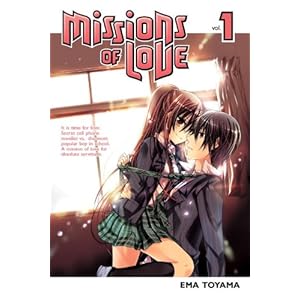


PLOT:  Yukina Himuro is perceived by her classmates as a distant, even frightening ice queen.  What they don't know is that she doesn't stare at them to intimidate them; she's observing them as research for her writing.  Yukina is secretly one of the most popular cell phone novelists on the market.  One day, she overhears a group of fans wondering why there isn't more romance in her work, and even though she has no experience with love or romance, Yukina becomes determined to experience it so she can incorporate it into her writing.  Circumstance intervenes when Yukina discovers that Kitima, the most popular and handsome boy in class, keeps a notebook full of his conquests and notes on how to exploit those around him for benefit.  Yukina uses this to force Kitima to be her romantic test subject, commanding him to do things to hold her hand or cuddle her or else be exposed as a manipulator.  Kitima doesn't take this situation lying down, and now the both of them are caught in a battle of wits and blackmail, all while Yukina tries to complete her missions of love.

STORY:  Well, this is unusually dark for a shoujo romance...and thank goodness for it!

I expected this story to follow that well-worn path for shoujo romances, where a socially awkward girl learns to open up and love thanks to the gentle affections of some perfect, popular dreamboat.  Now, there are ways to make that cliche of a storyline work (which I'll discuss someday whenever I get around to Kimi ni Todoke), but most mangaka just follow that outline to the letter with the results ranging from mediocre to dull.  Thus, when our supposed dreamboat is exposed to the reader as something of a manipulative bastard, my interest was peaked.

Shoujo love interests tend to be either impossible pictures of perfection or moody, tsundere-ish "bad boys."  Kitima is neither of these things.  Outwardly he appears to be the former, but his motivations are selfish and even lazy; he manipulates others not so much for gain as simply to make his life easier, or in the case of the girls, he manipulates them for his own amusement and observation.  He's not only a bit more like Yukina than he would like to admit, but he's also something of an awful person, and that is actual rather noe vel for shoujo.  My interest remained peaked when he spent the rest of the volume trying to manipulate others to turn on Yukina, and things only get more interesting when he utterly fails at it.

So, how does Yukina compare to him as a character?  Well, morally she may be a little better than him.  She's certainly more honest about herself than he is.  She's aware that the world perceives her as cold and distant, and for the most part she doesn't care.  She uses that distance to observe the world around her methodically and to incorporate all its little nuances into her work.  She brings that same methodicalness to romance - she needs to learn about romance, so she decides to use Kitima as her test subject and to approach each step of physical affection like an experiment.  Still, once she learns Kitima's secret, she's not above blackmailing him to keep her test subject in line, and she proves to be the mental equal of Kitima where manipulation is concerned.  Near the end of the volume, he does manage to learn her one weakness, and frankly it's a rather stupid one.  There's something of a kernal of emotional truth in Yukina's reason for her weakness, but it's still kind of a silly misstep in a series that had been running so smoothly and interestingly to that point.

Missions of Love is not your average shoujo romance, in part because its leads have some moral shades of gray to them and in part because at this point it's far less about the inevitable romance and more about two people engaged in a fascinating battle of wits, and I for one want this battle to continue.

ART: While the story of Missions of Love is surprisingly unconventional, the artwork is sadly much more conventional.  The character designs are unremarkable, with their plain faces and overly long, pointy, messy hair constantly flopping in their faces.  Like so many shoujo works, it makes liberal use of the sparkles and effects, and usually to the detriment of the panels they are used for.  The panels are larger than average, but the mangaka never really takes advantage of that extra space through the use of interesting angles or striking images.  Otherwise, the art for Missions of Love isn't necessarily bad, but its mediocrity hampers its otherwise interesting writing.

PRESENTATION:  The only extra to be found here are some brief translation notes and a bio.

RATING:

Missions of Love surprised me with its darker twists on the standard shoujo romance.  I can only hope that it can keep that twist going.

This series is published in the USA by Kodansha.  The series is ongoing in Japan, and the first of 8 available volumes is currently in print.

You can purchase this volume and many more like it through RightStuf.com!

Want a chance to win Volume 1 of this and 5 other series?  Leave a comment to enter the 12 Reviews of Christmas Giveaway here!

Wednesday, December 5, 2012

Review: OREIMO

The 2nd review of Christmas is a new title from Dark Horse (well, one that isn't a CLAMP omnibus).

OREIMO (Ore no Imoto ga Konna ni Kawaii Wake ga Nai, or My Little Sister Can't Be This Cute), adapted from the light novel series by Tsukasa Fushimi, drawn by Sakura Ikeda and Hiro Kanzaki.  First published in 2009, and first published in North America in 2012.


PLOT:  Kyousuke is an ordinary teenage boy who has a rather distant and thorny relationship with his younger sister Kirino.  She's a popular, pretty 14 year old who is also kind of moody and secretive...so in other words, she's very much like any 14 year old girl.  Then by accident, Kyousuke discovers Kirino's big secret: SHE'S AN OTAKU.  Not just any otaku, but one who loves magical girl anime and (more distressingly) little-sister theme eroges and the like.  She loves them so much that she keeps a stash of her merchandize hidden in her room, and even took up modelling to help pay for her habit.  After this discovery, Kirino begins to open up to Kyousuke, even if it's mostly just so she can have someone to talk to about her interests.  He in turn encourages her to reach out to other otaku, even accompanying her to an otaku meet-up at a maid cafe.  What will happen, though, when their father discovers one of Kirino's games around the house?

STORY:  Oreimo is marketed as a comedy, but I don't quite see it.  Well, I can see how it might work as one in Japan, but the main conflict that is supposed to serve as comedy is lost when you try to bring it to the USA, and the end result is kind of confusing and even kind of offensive.

Most of the comedy is supposed to stem from the notion of "HUR HUR, SHE'S POPULAR, ATHLETIC, AND PRETTY! SHE CAN'T BE AN OTAKU! NO ONE WOULD EVER SOCIALLY ACCEPT HER AGAIN IF THEY KNEW! ISN'T THAT IRONIC AND HILARIOUS!? HUR HUR!"  It's a rather crude joke, but I can see how it would fly in Japan.  There, you are very much expected to consume age-appropriate media once you grow up and to put aside things like video games and anime.  Those who do not are seen as childish, socially hopeless, and even as perverts.  Thus, the humor is supposed to stem from the conflict between Kirino's successful social image and her own embarassingly childish and perverted interests, even if she claims that she enjoys the eroges for the stories and the cute character designs.

The problem with this conflict is that it no longer works as comedy once you take it out of Japan.  American adults don't face nearly as much social pressure to give up geeky pursuits and media when they grow up - indeed, where would the internet be without them?  Thus, your average American manga reader would see no problem with being pretty, popular, athletic AND being into anime and eroges.  The manga repeatedly infers just how awful and shameful otakudom is, yet it is being marketed to those very otaku, and the manga is thus implying that its own audience is awful, shameful, and socially hopeless.  Oreimo is making fun of its own audience, and it's presuming that said audience is not self-aware enough to notice.  That's what makes it truly offensive to me - it's not laughing with its audience, but at them.

All that being said, what is the rest of the story like?  Oddly, while it fails as a comedy, it does sort of work as a family drama.  Kyousuke and Kirino's relationship initial relationship felt very familiar, where you regard your other siblings as weird and annoying and your whole relationship is strained because you're still growing out of being moody, bratty teenagers.  Their relationship actually got weirder the closer they got, between Kyousuke's repeated instances of calling his sister "hot" and Kirino's latching onto her brother and even trying to kiss him at one point.  Yeah, I know she states that she's not into incest, despite what her game choices would indicate, but I don't think the author fully wants us to believe that.  Also: ewwwwwww.

I will say that I like that Kyousuke isn't a spineless wimp.  He's understandably weirded out by Kirino's interests, but he does try to understand her interests and even consults some of his own friends to find ways to help Kirino interact with other fans like herself.  The results are kind of mixed, because Kirino has too much pride to befriend a bunch of nerd (and yes, that does make her a total hypocrite), but it's a genuinely nice gesture.  In truth, watching Kirino interact with the other otaku, including the tall, strapping, and completely oblivious ringleader and a gothloli cosplayer who almost instantly is at odds with Kirino, is probably the closest this volume gets to genuine humor.  Funny how that works when you try to base the humor on personality conflicts instead of shaming the audience indirectly.

When it comes to the story, Oreimo is a mixed bag.  The main conflict might work as source of comedy in Japan, but it falls flat on North American audiences.  The story actually is most effective when it focuses less on Kirino's otakudom and more on building a better relationship with her brother and drawing humor from putting Kirino into new situations.

ART:  The story of Oreimo at least tries to put a twist on the vaguely incesty little sister story; the artwork sadly plays it all too straight.

The character designs are very simple and moe-fied.  We're talking pure moeblob here - big wide-set eyes, barely any noses to speak of, simple lines for mouths, faces which are not very distinct and not terribly expressive - it's all there.  The art also goes out of its way to undercut the story's assertations that it's not supposed to be perverted through its constant sexualized gaze at Kirino.  Rare is the time that the panel is gazing down at her cutely pouting, or focused with laser-like precision on her ass, or setting her up into some vaguely suggestive position.  Even the cover sexualizes her, having her twist her spine into an impossible, Rob Liefeldian position to best emphasize her boobs and butt.  I can't take the story's denial of any pervy undertones seriously when it keeps presenting fanservice like this.

Backgrounds are exceedingly rare, as the majority of the panels are taken up by almost uncomfortably close headshots.  There was a suprising amount of chibi action, all within sillier moments and all featuring Kyousuke's hyper best friend, complete with the perky ears and wagging tail of an eager puppy.  The panels are larger than average, but when you use all that space for close-ups and fanservice, it's something of a waste of space.  It's mostly just there to attract and titilate the moe-loving otaku audience, and little else.

PRESENTATION: There's an afterword from the writer and artists, as well as a few gag 4-komas and an essay from the editor, who also seems oblivious to any weirdness about anything about this story.

RATING:
I was drawn to the more subtle, relationship-based elements of the story, but the otaku-shaming element falls flat and the moe and incest fanservice overwhelmed any relatable story elements.  Kyousuke may not be able to believe his sister is that cute, but I can't believe this series got licenced.

This series is published in the USA by Dark Horse.  The first of 4 available volumes have been published, and is currently in print.

You can purchase this volume and many more like it through RightStuf.com!

Want a chance to win Volume 1 of this and 5 other series?  Leave a comment to enter the 12 Reviews of Christmas Giveaway here!  

Monday, December 3, 2012

Review: A DEVIL AND HER LOVE SONG

Let's kick off the 12 Reviews of Christmas with a new series from Viz's Shoujo Beat line.

A DEVIL AND HER LOVE SONG (Akuma to Love Song), by Miyoshi Tomori.  First published in 2007, first published in North America in 2012.


PLOT:  Maria Kawai is a beautiful young woman who was recently expelled from her Catholic high school (a rarity in Japan), and is now transferring to public school.  Unfortunately, Maria is extremely observant, pessimistic, blunt in her speech, and honest to a fault, so she soon antagonzies her new classmates by pointing out their foibles.  It gets to the point where her fellow schoolgirls begin to actively act against her through rumors, pranks, physical assault, and attempts to incriminate Maria in the eyes of the teachers.  There are two students who don't immediately hate Maria, though.  The first is Yusuke Kanda, a cheerful blond boy who tries to put a positive spin on all things in life, including Maria.  The second is Shin Meguro, the class rebel who tends to go all tsundere around Maria.  Through it all, Maria tries to focus on what she learned from the nuns and to try and find the positive qualities in people.  Will Maria ever find the social equivalent of her saving grace?

STORY:  It's rather interesting to see a modern shoujo series where the heroine is such a pessimist.  Most shoujo stories star vulnerable ingenues, cheerful ditzes, or tempestuous tsunderes, but Maria fits none of these molds.  She does want to believe in the best of people, as she's been taught, but she also believes in being honest about herself and others, and by doing so she tends to point out all the flaws and faults in others.  Unfortunately for Maria, her classmates are a vicious little bunch of insecure sociopaths, so they lash out at her for disrupting their social status quo.  She can't even charm them with her looks, as she tends to wear a neutral sort of scowl, and her attempts to smile are...well, best not lingered upon.

Yusuke's also a rather fascinating character, as the manga clearly doesn't want you to believe that his brand of optimism is a good thing.  In fact, it all but states that Yusuke is deluding himself by repressing his negative qualities and blindly overlooking those in others.  Shin's perspective in comparison is more grounded, but he also fits closer to your typical brooding, Byronic love interest, always annoyed at how Maria will not defend herself against the slings and arrows of others.  The rest of the cast is not notable, as it seems to be mostly composed of Mean Girls who take every opportunity to lash out at Maria, regardless of circumstance, and as the volume progresses their actions escalate from mere passive-agressiveness to flat-out bullying (and thus escalate from relatively believable to something approaching ridiculousness).

Still, A Devil and Her Love Song manages to stand out from the crowd by focusing less on romance and more on its unique heroine and the constant conflict between her desire to find the best in people and finding only the worst.

ART:  The overall art style isn't terribly original, but Maria does stand out as a striking beauty with her dark bob, full pouting lips, and dark, limpid eyes.  The page layouts are a bit jumbled at times, with panels split up and stacked over one another.  The panels are very tightly focused, so expect a lot of talking heads and a lot of screen effects and tones instead of backgrounds.  Really, aside from Maria herself, the artwork is very typical of most modern shoujo stories.  As a whole it's effective, but it lacks any sort of distinct style and the quality over all is simply average.

PRESENTATION:  As true for most Viz works, there are few extras to be found.  Here all we have are a few character sketches and profiles.  I do want to note the cover art - I like that Viz stepped away from its usual solid-color framing for the Shoujo Beat line here.  Instead, they frame a lovely portrait of Maria through the use of roses, a cross, and the title itself, and the whole thing is nicely colored in shades of red and black.  It's a look that fits well with Maria's darker outlook on things and is very eye-catching.

RATING:
A Devil and Her Love Song may look a bit average, but its strange, pessimistic tone and unconventional heroine help to make up for any artistic faults it may possess.

This series is published in the USA by Viz.  The series is ongoing in Japan, with 13 volumes currently available.  6 volumes have been published in the USA, and all are currently in print.

You can purchase this volume and many more like it through RightStuf.com!

Want a chance to win Volume 1 of this and 5 other series?  Leave a comment to enter my 12 Reviews of Christmas Giveaway here!

Saturday, December 1, 2012

12 REVIEWS OF CHRISTMAS GIVEAWAY

As 2012 comes to an end, I decided to dedicate December to reviewing some of the latest manga titles to come out this year (and by 'latest', I mean brand new - no re-releases).  As it's also the holiday season, and thus the season for gifts, I also decided to do something special for my readers, whether you've been reading since May or just started stopping by.

From the 3rd to Christmas Day, I will be posting 12 reviews of 12 new series, and you the reader will have a chance to win your choice of 6 of them.  That's right - the winner will receive 6 brand-spankin'-new volumes of their choice from the 12 reviewed this month, along with a personalized thank you note from yours truly.

How do you enter?  It's very simple.  You just have to leave a comment below noting what your favorite manga release from 2012 was.  It can be anything - single volume or omnibus, brand new or ongoing.  Simply state what that release was and why you liked it, and on Christmas Day one commenter at random will be chosen to win the aforementioned gift package.

Of course, there's no way to know what you might win unless you keep reading, so stay tuned and good luck!

Tuesday, November 27, 2012

One Volume Wonder: RED BLINDS THE FOOLISH

Sorry for the delay folks - I was finally able to rouse myself from turkey-induced stupor and able to tear myself away from many an online deal to offer up one last review this month, as well as a return of the One Volume Wonder.

Now, I am not afraid to admit that I do read and enjoy yaoi.  I am also not afraid to admit that when it comes to yaoi, I am very particular about which ones I read, because sadly Sturgeon's Law applies to yaoi, i.e. that 90% of is awful.

Originally I was going to use this spot to review yet another work by Fumi Yoshinaga, who did quite a few one-shot yaoi stories before branching off into josei.  I've already covered two of her works, though, so I decided to turn my focus on yet another underrated mangaka who is known for both BL and josei works: the unconventional (and uncapitalized) est em.  She's getting a bit more exposure thanks to sites like JManga, but today I want to look at one of her previous, physically published works.

RED BLINDS THE FOOLISH (Oroka-mono wa Aka o Kirau), by est em.  First published in 2008, and first published in North America in 2008.


PLOT:  Rafita is the latest and greatest thing on the Spanish matador scene, famed for his brilliant red costume as well as his stoic and fearless performance in the ring.  He soon takes up with Mauro, one of the butchers who processes the bulls that Rafita slays.  Rafita treats their relationship as if it's no big deal, but soon Rafita starts to lose his nerve in the ring, and the cause may stem from Mauro.  There are also stories about the soccer fan who meets up with the security guard who gave him quite the shiner in a mid-game brawl, a writer with an attachment to an old pair of red heels, and a writer taking down the story of an old man and his past as a choreographer for a French ballet dancer.

STORY:  Red Blinds the Foolish is a breath of fresh air for anyone familiar with yaoi as a whole. It looks like no other yaoi on the market, it reads like no other yaoi on the market, and I am so very thankful that something like this exists.

Noteably, this isn't a single, linear story but an anthology of mostly unconnected ones.  Secondly, they all feature an usual setting for manga - Europe (Spain, specifically).  Admittedly, est em utilizes that setting rather shallowly.  Sure, she incorporates elements like bullfighting and soccer, but she also seems to ignore the fact that Spain is a predominately Catholic culture, and as such there might be more conflict and concern for a gay man in Spanish culture, particularly one who is a prominent media figure like Rafita.

The volume is dominated by the title story, which is plot-wise the most complex as well as the artiest and most philosophical of the lot.  Rafita starts as a cocky and somewhat shallow man, the kind who can stare down death even as it stampedes towards him or call his lover in the middle of screwing another man.  By story's end, he has lost some of his fearlessness but has traded for some genuine concern and affection for Mauro.  Mauro admittedly doesn't have quite as much of a character arc, although a bit of his backstory is filled in through one of the later chapters.  He is sedate and calm, willing to wait things out and let Rafita figure things out on his own.

est em also doesn't linger too much on how anybody on this volume gets together.  It simply just sort of happens somewhere offscreen (offpage?).  I guess this does allow her to get past any of the characters' possible anxieties about whether the other party is gay, much less if they are into them, and it's an understandable shortcut when she doesn't have a lot of pages to spare.  Still, it leaves these relationships feeling a bit uncomplete as even during sex the stories feel a bit emotionally cold.  Mind you, part of that comes from the fact that we're mostly not seeing the complete arc of these relationships, but mere vignettes of their lives.

OK, so while her works are not perfect, there are a lot of good and cliche-defying things to say about Red Blinds the Foolish.  First of all, for all of you out there sick to death of the whole seme/uke cliches?  This is a manga for you.  Here, none of the men are forced to fit any particular roles in the relationship (or in bed) beyond "significant other," "friend," or "associate."  Secondly, these are all working adults - no high school kids, no college students, just god-to-honest grown up MEN.  Third, she also doesn't force the sex into the story, as many a BL mangaka do to keep up audience interest.  While she's not afraid of including sensuality in her work, she's not in it for the porn but instead for the characters and the relationships between them.  It's more of a mature work in the sense of the writing and the sedate, intelligent tone versus being 'mature' in the 18+ sort of way.

While Red Blinds the Foolish is far from perfect, it's an interesting and mature collection of stories and it's a welcome spot of relief in the sea of hysterical ukes, aloof semes, and flowery sex scenes.

ART:  est em also distinguishs herself from the crowd through her lovely, realistic artwork.  Here her men look like actual, individual European men, instead of the highly stylized and feminized character designs one usually sees in yaoi.  They have actual musculature!  And butts!  And even body hair!  When was the last time you saw yaoi that acknowledge that men might have hair in places other than their heads?

There is a certain sketch-like quality to est em's art, particularly in the faces in closer shots or the sometimes hastily drawn details of Rafita's costume.  Her backgrounds are often blank, although here this is not a detriment simply because est em frames every panel so beautifully and elegantly that you hardly mind - to add more to the panel would spoil the effect.  There are a wide variety of simple, confident angles in the panels, along with some equally well-done intercutting of panels during moments of action (in every sense of the phrase *eyebrow waggle*).  Overall there's a sense of confidence and simple beauty in the art which not enhances the tone of the story and goes a long way towards not only distinguishing est em from other BL mangaka, but from manga artists as a whole.

PRESENTATION:  There are a couple of pages of author's notes about est em doing research for this volume, packed to the brim with notes and sketches.  I did like the little touch of her drawing herself and her friend "C" as C-3PO and R2D2.

RATING:
The look and subtlety of Red Blinds the Foolish  more than make up for any faults it might have, and anyone who has ever been wary or weary of yaoi should give this and the rest of est em's catalogue a look.

This was published in the USA by Deux Press, and is currently out of print.

You can purchase manga like this and much more through RightStuf.com!

Well, it was certainly fun for once to focus on the good stuff for once.  Next month promises to stuffed with even more reviews, as well as a very special giveaway.  Come back this weekend to find out the details!