Monday, September 9, 2013

Review: MILLENNIUM SNOW

So, last time I look at Black Bird, a supernatural romance that is a shining example of how to make such things irritating and dull.  So that begs the question: is there a way that it can be done right?  Can a supernatural romance be done in an entertaining way?

MILLENNIUM SNOW (Sennen no Yuki), by Bisco Hatori.  First published in 2001, and first published in North America in 2007.


PLOT:
Chiyuki has a problem.  She was born with a weak heart, and her heart only gets weaker with every year.  Because of that, she's spent most of her childhood in the hospital, and every year she hopes to make it to the next snowfall.  One evening, she witnesses a boy falling off the hospital roof.

Below, Chiyuki finds a young man, complaining of filthy humans and the scent of blood.  This boy, Toya, is a vampire, although he doesn't quite fit the ideal.  Sure, he's vulnerable to things like garlic, but he can tolerate sunlight just fine and can survive on human food when blood is unavailable (which is good, because he actually has a major distaste for blood).  When he bites a victim, he doesn't turn them, but instead bestows extended life upon the victim and binds himself to the victim.  Chiyuki sees this as her salvation.  Toya sees this as a nightmare, being a bit of a sensitive, introspective boy.

Toya eventually yields to Chiyuki's request, and now the two must learn to get along as Chiyuki tries to bring Toya into the human world.  Things only get more complicated when they meet Satsuki, a handsome classmate with a hairy little secret.

STORY:
I know what you guys are thinking.  You see a story involving a human girl caught in a love triangle with a grumpy, handsome vampire and an equally handsome werewolf, one where the girl constantly begs the vampire to bite her.  You are likely getting Twilight flashbacks and recoiling at the thought of reading yet another story like that. 

Well, let me put your fears at rest - Millennium Snow is no Twilight clone.  It's far more lighthearted, it isn't asking us to accept the vampire as the ultimate romantic hero, and the werewolf is far more cheerful and far less prone to stalking.  The best part is that here, the girl has a perfectly good reason for wanting to be bitten - for her, it's literally a matter of life and death.

I really like the characters.  Chiyuki seems a bit bland at first, but after being bitten she becomes much more lively, and you get a real sense that this is the self she has always wanted to be.  She's relatively proactive as well - she's willing to give the men around her a piece of her mind and is not swayed solely by the bishies around her.  I really enjoyed Toya, and I suspect a lot of that is due to how he doesn't fit the mold of the typical manga vampire.  Most vampires in manga are beautiful, seductive creatures, and a few are just outright mad monsters.  Toya is neither of these, instead being high-strung and neurotic, qualities which in turn conceal the loathing he has for his condition and his fears of loneliness and rejection.  He's no Casanova - he's grumpy comic relief.  If anyone fits the role of beautiful seducer, you would have to look to Satsuki, whose cheerful, flirtatious nature conceals his own insecurities about his own identity as an orphan and as a werewolf.

This sounds like it could get a little too serious and dramatic for its own good, but thankfully Hatori never lets things get TOO serious.  This is aided by Yamimaru, a goofy little bat who serves at Toya's minion, emergency food supply courier, and giver of exposition.  He's useful enough at the beginning, but once the main plot gets going he disappears.

I should note there's also a short story afterwards, an early prize-winner from Hatori's early days.  It's about a couple of best friends, one of whom has a strange sort of split personality.  It's a solid little story with a bittersweet ending, and it's an nice little inclusion.

Millennium Snow is a novel little twist on supernatural shoujo romance, one that is strengthened by its well-rounded characters and its avoidance of the clichés of the genre.

ART:
Even by this point, Hatori had settled into her own distinct visual style.  While her character designs fall very much in line with much modern shoujo, being all long legs and angles, she draws them lightly, with fine, fairly detailed linework and enormous, shimmering, and expressive eyes.  In some ways, this really was a warm-up for her best known series, Ouran High School Host Club.  It's certainly true when it comes to the character designs: Toya looks like Kyouya without his glasses, and Satsuki is pretty much a double for Tamaki. 

One advantage this series has over later works like Ouran is that its panels are far less busy, since it's working with a smaller, less commentative cast.  Instead she uses that space for more close-ups.  This sounds claustrophobic, but she tends to leave the borders off the panels, which only enhances the lightness of her art.  Backgrounds are sparse, and tend to be filled with very plain washes of screentone or speed lines.  Hatori's art style might not be the most visually exciting, but it's delicate and eye-pleasing, and she finds a good balance between personal style and shoujo conventions.

PRESENTATION:
There are translation notes, as well as an omake under the title of "Egoist Club," where she shares some character profiles of the cast.

RATING:

It's a shame that Hatori abandoned this series for so long, because it's a pleasantly unmelodramatic take on vampire romance, and one that I would recommend to others.

This series is released by Viz.  The series is ongoing, having been recently restarted, with 3 volumes available.  2 volumes have been published, and both are in print.

You can purchase this volume and many more like it through RightStuf.com!

Wednesday, September 4, 2013

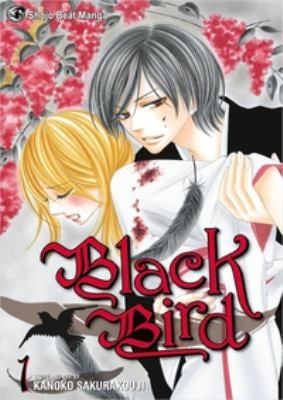
Review: BLACK BIRD

I've made no secret of my fondness for shoujo manga, and equally so I've made no secret of my despair over how some shoujo series revel in the very worst of the genre: insipid heroines, abusive love interests, shallow relationships, lackluster art, and so forth.  So this month I'm doing a sort of compare and contrast of selected shoujo works, reviewing two works with a similar theme that show how said theme can be done right and how it can be done wrong.

I'll get things going with an extremely popular shoujo series - indeed, until Kodansha started rereleasing Sailor Moon, it was one of the best selling shoujo series on the market.  It's also one of the worst things I've read since starting this project.

BLACK BIRD (Burakku Baado), by Kanoko Sakurakoji.  First published in 2007, and first published in North America in 2009.


PLOT:
Misao Harada has been able to see spirits and demons all her life, and sadly all it's done for her is make her appear spacey and clumsy to normal people since they can't see the spirit world tormenting her.  Her only consolation comes from the fond but vague memories of Kyo, a young boy who could also see the spirits and promised to come back to Misao someday.

It turns out Kyo is true to his word and then some.  It also turns out he's a demon, a tengyu to be specific.  He has returned because for reasons unknown, Misao is a particularly tasty morsel to the denizens of the spirit world, the kind that only comes once a century.  To drink her blood will grant long life; to eat her flesh will bestow eternal youth; her hand in marriage will bring great prosperity to any demon clan that claims her.  Now that she is 16, it's open season on Misao, and Kyo is determined to make Misao his at any cost.  Even if it means following her every move, posing as one of Misao's teachers, and fighting off every creature that comes for her, Kyo will have his prize.

STORY:
I was perfectly willing to give this story a chance, even if the "ordinary kid is tormented by various spirits" has been done before by better and more interesting manga.  Then Kyo showed up and I spent the rest of the volume wavering somewhere between revulsion and rage.

I thought I had seen hopeless, hapless shoujo heroines before, but Misao truly takes the cake.  She is never at any point proactive in this story.  Once the demons start showing up, all she does is cry, cower, and bleed, always waiting for someone else to save her.  I'm not saying that she should be able to kick loads of demon butt, but would it honestly hurt the story if she at least ATTEMPTED to defend herself?  Could she have just enough brain cells to rub together to know that maybe she shouldn't follow strangers lest they turn out to be demons out to eat/screw/do god knows what to her?  If she were carried off any more often, she might as well have a handle on her back to better facilitate her frequent kidnappings.  Personality-wise she's not much better, because Misao spends the majority of her time vacillating between two moods: hating Kyo for being so controlling and (OF COURSE) falling in love with him because he's hot and he saves her all the time.

Misao is only half of the problem I had with Black Bird.  The other half is Kyo, or as I had mentally dubbed him halfway though, "Professor Bad Touch."  He's like a walking checklist of cheesy shoujo fetishes.  Don't believe me?  Let me count the ways.  He's a dark, tall and handsome (1) supernatural being (2) with wings (3).  He's an older man (4) who sometimes wears glasses (5) to better play the role of Misao's teacher (6).  He's a white knight (7), always rescuing her and whisking her away to his large mansion, complete with servant (8), and he heals her injuries by suggestively licking her body (9).  There's probably more I could think of with time, but I suspect you all get the idea.  He's also quite the stalker, which for some might count as #10.   From the moment he reintroduces himself into Misao's life, Kyo is determined that no one but him will possess Misao, and that she WILL marry him.  This is not phrased as a question, but as a command or at least as a certainty that Misao is stupid for fighting against.  Then, to make doubly sure that Misao is never too far away, Kyo installs himself at her school as a teacher, so now he is literally an authority figure to whom Misao has to obey.  At no point could I discern Kyo having any real affection for Misao - all he feels for her is possessiveness, and frankly that makes him no different that the demons he fights.  But we the readers aren't supposed to think that.  We're supposed to swoon over him, because he's just so handsome  and so wonderful and so caring and how romantic it is that his every consuming thought is about this girl who is totally unworthy of him!

Why do I get the feeling that Twilight fans would love the hell out of this manga?

Speaking of Twilight, there's a frequent focus on bloodsucking and bloodplay between our two leads, whether it's a classic vampire-style feeding or licking injuries on various parts of Misao's body.  These acts are always staged like sex acts, which adds enough weird subtext on its own.  It only gets  worse when you consider that Misao is not always conscious for these acts, and it was at these points that I longed to find and press the BAD TOUCH WE NEED AN ADULT button.  It's weird how much emphasis is placed on this considering that Kyo is NOT a vampire and tengyu are not generally known for eating people or blood, which leads me to think that this is something of a favored kink for Sakurakoji.  .Unlike her, I don't get off on the combination of blood and sex, and this meant that a lot of the so-called 'sexy times' in this manga left me feeling rather disturbed, and it's just as much because of the "TMI, Sakurakoji-san" element as it is about the blood itself.

What can I say for Black Bird?  Well, I am genuinely surprised that it's such a popular series because it's built around two utterly vacuous characters, one being weak and helpless, the other less a character and more a mass of clichés.  It expects us to cheer on what is in truth a possessive and one-sided relationship and to thrill at a very literal combination of sex and violence.  Mostly what I wanted to do with Black Bird was to throw it at the wall as hard as possible and try to scrub the taint of its creepiness off of my flesh.

ART:
The artwork as a whole is terribly unremarkable.  The character designs are extremely generic, to the point where Sakurakoji seems to be able to draw only one sort of male face (generic bishonen) and one female face (simpering moeblob, so simplified that they often appear to have no noses).  They're not terribly expressive, either.  For example, Kyo only seems to have two emotions: Mildly Pissed and Creepy Leering.  There's a nice variety in panel shape and size, but they're assembled in a rather messy manner and it detracts from the big splash panels of Kyo which I presume were meant to be the highlight.  She's not much better with action, as she tends to just break out the speed lines and call it a day.  Even the backgrounds are rather plain.

I've already gone over the squickiness of Sakurakoji's blood fetish, but there's something else in the art that rather disturbs me.  There's a lot of imagery, from the cover to the last splash pages, that puts emphasis on Misao being restrained, unconscious, or is visibly upset.  Such imagery only emphasizes Misao's helplessness and the inequality of her relationship with Kyo, and when combined with the story and the bloodplay, the whole thing comes off as rather sleezy and exploitative, like an old-fashioned bodice-ripper.  It would be one thing if all of this was done so on purpose and the reader was supposed to be conscious of the innate wrongness and messed-up quality of the romance, but this is played perfectly straight, and that's what makes this work so utterly offensive to me.

PRESENTATION:
Nothing to see here.

RATING:
Avoid this one like the plague.  Black Bird's notions of romance are creepy, sleezy, and despicable, and visually it's dull as dishwater.  Leave this one to the Twihards and find yourself some GOOD shoujo to read.

This series is published by Viz.  The series is complete with 18 volumes in Japan.  16 volumes have been published so far, and all are currently in print.

You can purchase this volume and many more like it through RightStuf.com!
Friday, August 30, 2013

Review: THE DRIFTING CLASSROOM

One last old-school work for the month, and I'm taking things out with yet another 1970s series.  This one, though, is very different from the others I've reviewed.  This time it's a horror series by a mangaka who is just as well respected as the others I've covered but is far less well-known or renowned.

THE DRIFTING CLASSROOM (Hyoryu Kyoshitsu), by Kazuo Umezu.  First published in 1972, and first published in North America in 2006.


PLOT:
One morning, Sho wakes up in a bad mood.  It's not his fault, though.  She didn't wake him up on time, plus she threw out all the treasures and things he had kept stashed in his drawer!  So like a brat, he trashes the breakfast table, yells at his mother, and basically acts like a wee little bastard.  That would probably be the most notable thing about his day, if this day were like any other.

That day, Sho's elementary school disappears in a loud explosion.  This sounds like the end of the story, but it is only the beginning, for the school did not truly explode.  Instead it was transported to an unknown dimension, a blank vast wasteland that kills those who venture out into it.  As the families left behind try to figure out what happened, those within the school - staff and student alike - begin to panic as they come to grips with the fact that they are trapped in a place with no way out and no way to communicate their plight to the world.

STORY:
The best summary of the story would be to simply call it Mass Hysteria: The Manga!  At first this seems like it will solely be Sho's story, but once the school is teleported the story widens its focus to encompass some of the other fellow students and staff members around Sho.  The way people react to their situation, as unreal as it may be, is very realistic onto itself.  Some try to be proactive and try to leave or communicate with the world.  Some curl up into a gibbering mess.  Others give in to their basest instincts and lash out at others. 

This part takes up roughly the second half of the story, and it's so deadly serious in tone as to make the first half kind of ridiculous.  It doesn't help that I found Sho to be an insufferable little brat.  I didn't want to follow this kid's story, I wanted someone to smack him!  Still, he gets the lion's share of character development here, so I guess we the readers are stuck with him.  It is worth sticking it out, though, because once things get supernatural, they do get very good.  Unlike a lot of horror manga, the horror here doesn't come so much from the supernatural forces at work so much as it comes from the despair and horror of the human mind when faced with a disaster it could never imagine, never prepare for, and is seemingly hopeless to fight against.

ART:
I'm glad that the story is pretty solid because this has to be some of the ugliest artwork I've seen in a manga.  The faces are strangely realistic, but also very stiff and seemingly too small for the characters' heads.  It doesn't help that their reactions come in one of two variations: Realistic and Completely Over-the-Top Cartoony. The only that does seem to express itself are the characters' eyebrows.  It's particularly weird when characters cry, because it looks like their eyes are melting, which is horrific all on its own but not what the mangaka intended.  There's very little flow of action between panels, and the ones where characters run are the goofiest look things ever, stuck in a jaunty running pose like an action figure floating in the background. 

Indeed, the artwork as a whole is very dark and unshifting, regardless of mood.  The backgrounds are equally dark and detailed, full of hatching.  That's one of the few places where the darkness works, as it effectively matches the dark and foreboding mood of the work.  Sadly, it can't compensate for the stiffness and oddness of the characters within it, and it sometimes undercuts the seriousness and horror of the story.

PRESENTATION:
There's a surprisingly thorough biography of Umezu, as well as a bibliography of his works.  It's nice that Viz chose to give the reader some context for the mangaka as well as this work.

RATING:
The psychological horror in the story is fascinating, but it sadly can't compensate for the hideous, stiff artwork.

This series was released by Viz.  All 11 volumes were released and are in print.  This series is also available in full in e-book form via Viz Digital.

You can purchase this volume and many more like it through RightStuf.com!

Friday, August 23, 2013

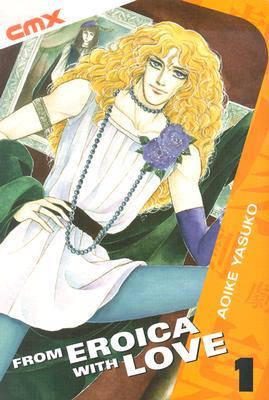
Review: FROM EROICA WITH LOVE

Oh man...you guys have no idea how much I've been looking forward to this review.  Sure, it fits in with the theme because it was created by another Year 24 mangaka, but this is truthfully one of my favorite manga ever and I want you all to know why.

FROM EROICA WITH LOVE (Eroica Yori Ai o Komete), by Aoike Yasuko.  First published in 1976, and first published in North America in 2004.


PLOT:
We start with three cute, pleasant high school students who are not only gifted with ESP, but also super strength and genius-level intellect.  They're not important, though.  Who is important is the beautiful blond man who wanders into their story at an art museum.  This man is Earl Dorian Red Gloria, an admirer of beautiful art and beautiful men.  He is a man who gets whatever he wants, and what he can't get through money or cajolery he will get through theft.  The only person that can stop him is Major Klaus Heinz von dem Eberbach, a West German NATO officer who is strict, officious, and disdainful of all that Dorian stands for, and circumstance keeps throwing these two together in all sorts of international crises.

STORY:
It's rare to see a manga shift focus as quickly as From Eroica With Love does.  It's rarer still that such a radical shift works to the story's benefit, not against it.

It becomes glaringly obvious that the psychic Scooby gang from the beginning can't begin to hold a candle to Dorian.  His stunning, Robert Plant-inspired looks and suave, worldly ways don't just steal the scene, they steal the whole damn storyline!  Yasuko seems to have realized this as well, because those kids all but disappear after that first chapter.  Frankly I'm Ok with their loss, partially because the psychic and superpower angle was really goofy and underutilized, and partially because they had little to no personality, so nothing of value was lost.  Once Dorian takes the metaphorical wheel of the plot, that's when the story finally finds its tone and focus.

From that point on, it's a jet-setting adventure story, where Dorian and Klaus find themselves at varying degrees of opposition over some fabulous piece of art.  The story is full of energy and the tone manages to balance the action and the humor expertly.  You'd think such a story would get tiresome after a while - Dorian sees shiny thing, Dorian like shiny thing, Dorian steals shiny thing, Dorian and Klaus flirt banter a lot.  Luckily, Yasuko keeps things interesting by making their relationship not-so-strictly adversarial.  At points Dorian and Klaus must team up to achieve a common goal (even if they do so for different reasons), and Dorian makes some genuine effort to understand Klaus and his worldview.

The story would work half so well without a worthy adversary, and Klaus is more than worthy.  He's not only a strong character in his own right, but he works as both adversary and comic foil to Dorian.  The greatest joy in this manga is watching these two interact, seeing someone so straight-laced and uptight have get so flustered and frustrated with someone who is at once both cunning and decadent, but yet so outwardly friendly and flirtatious.  Oh, did I mention that this story is purposefully and blatantly slashy?  One of the reasons this work (and the mangaka that created it) is so influential is that at the time of its creation, it was revolutionary to have any sort of man-on-man action.  Yaoi and shonen-ai were only just coming into being as separate genres, and were ones rarely seen outside of the doujinshi circles, so it was and is remarkable to see so much blatant slashiness in something published in a shoujo magazine.  Hell, most modern day yaoi and shonen-ai works could only wish they had half as much plot and adventure as this manga, or had characters that were this engaging.

There's a fair bit of humor to be found outside of our main duo, though.  There are quite a few fourth-wall breaking jokes where characters comment on how they must not be in the right manga or on the quality of their own story.  There's also Dorian's gang of minions, most of which are named and modeled on the other Led Zepplin members, with the most prominent of them being Dorian's miserly, neurotic, and openly gay accountant James (yes, as in Page.)  While the story never becomes an outright farce, it keeps enough humor to keep things very lighthearted, and the heists onto themselves throw in a few unexpected turns to keep everyone (even Klaus and Dorian) on their toes.

I could honestly talk about From Eroica With Love all day because it's just so damn good.  It may have a bit of a shaky start, but it turns itself about very quickly and in doing so becomes an incredibly well-polished, confident, and flat-out entertaining story.

ART:
Much like my previous review of Swan, Eroica's art is blatantly rooted in 1970s shoujo style.  All the men (even Klaus!) have long flowing hair, although none can compare to Dorian's lush mane of waves.  The eyes are all narrow, glittering, and dark.  The chins are uber-pointy and the bodies are all ridiculously long and skinny.  People tend to be terribly pretty, if rather broadly expressive.  Yasuko clearly loved drawing all of Dorian's wardrobe, considering all the detail lavished on his many loose, flowy shirts, large draping coats, and impossibly tight pants.  She doesn't leave a lot of room for backgrounds in the panels, but those present are simple but nicely drawn.  The page composition is fairly standard, breaking out the larger panels for dramatic moments.  Overall, the artwork is rather dated, even more so than the story.  Still, it's not as visually busy as some of its contemporaries, which makes it easy to follow, and it is attractive in its own right.

PRESENTATION:
The only thing resembling an extra is a plot summary for the next volume.

RATING:
This is another classic of 70s shoujo.  It's a great adventure built around two great characters and I'm so glad this got release here, even if it was never finished and never sold well.

This series was released by CMX.  This series is ongoing in Japan, but only 15 volumes were released and all are out of print. 

You can purchase manga like this and much more through RightStuf.com!

Wednesday, August 14, 2013

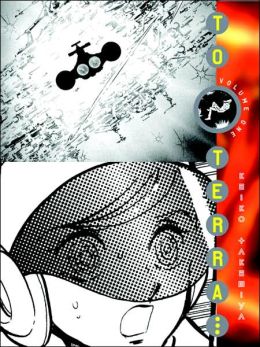
Review: TO TERRA....

Sorry for the delay - I went to visit some college friends this weekend, and it's taken a little bit to get back on track as far as my usual routine.  So, we're moving ahead from the 50s to the 70s (as sadly manga from the 1960s is not terribly well represented on the American market save for the collective works of Osamu Tezuka).  We're also looking at one of the members of the Year 24 Group (also known as the Fourty-Niners), an informal group of female mangaka born in 1949/Showa Year 24 who set many of the standards and subgenres for shoujo as a whole, and this sci-fi classic is a wonderful indication of what kind of groundbreaking she was doing.

TO TERRA...(Terra e...), by Keiko Takemiya.  First published in 1977.  First published in North America in 2007.


STORY:
Somewhere in the future, the Earth is at absolute limits.  To help conserve the planet, humanity takes off for the stars.  There they establish the age of Superior Domination, where children are bred by a universal computer, placed with foster parents, and then as teenagers are placed on adult colonies where the computer determines who amongst them is worthy of being sent back to Earth, or "Terra."  What the computers could not anticipate was the creation of the Mu, physically handicapped individuals who also possess powerful psychic and telekinetic powers.  The Mu are exiles from humanity as a whole, but they too harbor plans and aspirations to return to Terra.

The story focuses on two young boys: Jomy Marcus Shin, a 14 year old on the cusp of his Maturity Check, and Keith Anyan, a boy on the fast track to leadership.  Jomy is brash, moody, and rebellious, and discovers that he is in fact a Mu.  He is rescued by a hidden Mu ship only to discover that his powers are not just a quirk, but may represent the future of the Mu.  Keith, on the other hand, is a brilliant student on his colony but is distant and cold with others.  It takes a prodigy by the name of Seki Ray Shiroe to make Keith start questioning both the order of his society as well as his own past.

PLOT:
It's not unusual to find a sci-fi story about one or more people rebelling against an oppressive or tyrannical government both inside and outside of manga.  To Terra distinguishes itself from the pack by exploring this well-worn brand of conflict from both sides, from the views of both the oppressed (the Mu) and the oppressors (the humans).  By doing so, she gives this old conflict some moral complexity and ambiguity, making it less a tale of Good vs. Evil and more about two souls who want to explore and break out of the limits set by their own societies.

It certainly looks like a Good vs. Evil story at the beginning, with Jomy representing the Good (albeit a moody, whining sort of Good) and the adults representing the Evil.  Then he is shanghaied by the Mu and all but forced into becoming their leader, since he is the first Mu to possess both great mental powers and a physically hale body.  My only problem with that is that once Jomy becomes their leader, he seems to lose what personality he had for a good chunk of the volume and accepts the role of leader without question. 

He gets better after a flash forward, where we see hints of the old Jomy as he butts heads with the Mu leaders over if it would be better to establish a new home world or to keep pursuing a return to Terra.  Jomy's journey from boy to man and from skeptic to leader would be a perfectly fine story arc on its own, but Takemiya is willing to give the story greater depth by looking at things from the human's side of things by looking at Keith.

Keith seems to be the perfect example of non-Mu humanity, being a top student and athlete, albeit one with few acquaintances and no friends.  He's also a common character in science fiction, one who is a functioning member of an oppressive society until his eyes are opened to the truth.  The truth in this case comes from Seki, who not only beats Keith in practically every field but also questions and rebels against the system and the computers that control everyone's life, and Keith's irritation at Seki soon transforms into questions of his own about himself and his fate. 

By showing Keith's story, Takemiya humanizes both sides of the human/Mu conflict.  We see that those under SD control are not all happy, mindless drones - there are those within the system who question it and their own purpose within it.  Keith and Jomy end up being parallels to one another, despite their never meeting - both are young and gifted, both quickly become leaders within their own societies, and both find themselves questioning the morality and direction of their respective cultures.  It's unknown at this point whether Keith and Jomy will meet, but I can only hope that if they do, the results are just as fascinating and complex as their lives so far have been separately.

ART:
Being a manga from the 1970s, it may take a modern reader some time to get used to Takemiya's now old-fashioned style.  Like most older mangaka, Takemiya takes some cues from Tezuka, particularly in their similiarly and somewhat cartoonish character designs.  Still, there is a delicacy to Takemiya's linework, and the dark glittering eyes of her characters are very much a visual signature of 1970s shoujo. 

There are some beautiful vistas in this manga, be they the abstract recesses of a character's mind or the vast scope of space and machinery.  Takemiya puts a lot of detail into the planets and spaceships her characters inhabit both inside and out.  Her page composition complements the beauty of her artwork as well, as the panels tend to be big and loosely bordered, allowing for a lot of layering and lovely-looking montages.  She takes advantage of all that space with plenty of one- and two-page spreads of space itself, which helps to highlight the isolation of both human and Mu, as well as the very literal distance between both parties and their mutual goal of Terra. 

Takemiya's artwork may be a touch old-fashioned, but it's also very beautiful and evocative, using
scale and sheer artistic skill to enhance the drama and conflict of her characters.

PRESENTATION:
This was released early in the life of Vertical, when most of their manga covers took a more Pop Art influenced approach, contrasting the title with selected panels of the work inside.  This was also the time where they would put brief blurbs about selected cast members on the back, but as they only cover about four or five characters at a time, they feel rather incomplete.

RATING:
This title has earned its classic status by take a well-worn sci-fi set up and turning it instead into two parallel tales of opposing forces, with two future leaders who are sowing the seeds of rebellion within their own cultures.  This story is in turn complemented by its beautiful artwork, which gives their futuristic world a sense of both scale and beauty.  I cannot recommend this series hard enough.

This series was released by Vertical.  All 3 volumes were released, but all are currently out of print.

You can purchase manga like this and much more through RightStuf.com!